
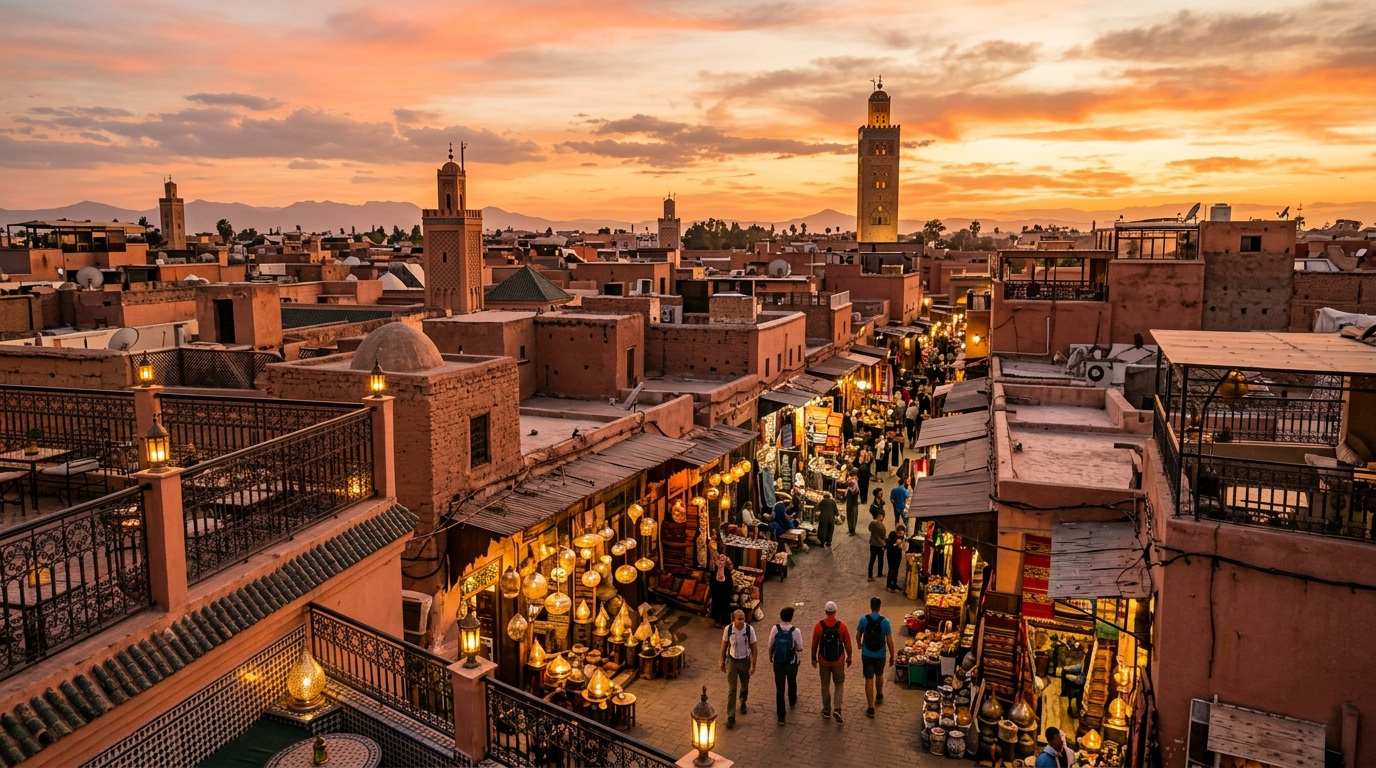
Your Complete Guide to the Magic of North Africa
This Morocco travel guide will help you discover the best cities, the safest travel tips, and the best time to visit Morocco.
1. Introduction
Morocco is one of those rare places in the world that manages to be everything at once — ancient and modern, spiritual and sensual, wild and welcoming. Tucked at the northwestern tip of Africa, this kingdom has been drawing travelers for centuries, and for good reason. From the snow-dusted peaks of the Atlas Mountains to the golden sand dunes of the Sahara Desert, from the labyrinthine alleyways of medieval medinas to the crashing Atlantic surf, Morocco is a destination that overwhelms the senses in the most wonderful way.
Every year, more than 13 million international tourists make their way to Morocco — and the numbers keep growing. What brings them? Perhaps it is the extraordinary cuisine, the warm hospitality of the Moroccan people, the impossibly photogenic blue streets of Chefchaouen, or the magical atmosphere of a Marrakech sunset. Whatever draws you in, one thing is certain: Morocco will stay with you long after you return home.
This guide will walk you through everything you need to know to plan an unforgettable Moroccan adventure — the best cities, the safest practices, the must-eat dishes, and the hidden gems that most tourists miss.
Table of Contents
2. Where Is Morocco and Why Visit It?
Morocco occupies a unique geographic crossroads, bordered by the Atlantic Ocean to the west, the Mediterranean Sea to the north, Algeria to the east, and the vast Sahara Desert to the south. Its proximity to Europe — just 14 kilometers across the Strait of Gibraltar from Spain — makes it one of the most accessible African countries for Western travelers, yet it feels like stepping into an entirely different world.
The country blends Arab, Berber, Andalusian, and African cultures into a rich, layered identity unlike anywhere else on earth. You can drink mint tea in a 14th-century riad, ride a camel at sunset over Saharan dunes, hike through cedar forests where wild Barbary macaques roam free, and surf world-class Atlantic waves — all within the same week.
Morocco is also a country of contrasts. Glittering cosmopolitan cities sit alongside remote mountain villages. Modern highways connect ancient ksar fortresses. High-speed trains whisk travelers between cities, while mule carts still navigate medina alleyways too narrow for cars. It is this layering of the old and the new, the familiar and the foreign, that makes Morocco so endlessly fascinating.
3. Best Cities to Visit in Morocco
Morocco’s cities are diverse and each has its own distinct personality. Whether you love history, architecture, beaches, or simply wandering without a plan, there is a Moroccan city for you.
Marrakech
Often called the “Red City” for the terracotta hue of its buildings, Marrakech is the undisputed jewel of Moroccan tourism. The heart of the city is the Djemaa el-Fna square — a UNESCO-recognized cultural space that transforms each evening into a swirling circus of storytellers, musicians, snake charmers, and food vendors. The Medina’s souks are a sensory labyrinth of spices, leather goods, ceramics, and textiles. Beyond the old city, the lush Majorelle Garden, the ornate Bahia Palace, and the historic Koutoubia Mosque are essential visits.
Fes
Fes is Morocco’s spiritual and intellectual capital, home to the oldest university in the world (the University of al-Qarawiyyin, founded in 859 AD) and one of the world’s best-preserved medieval cities. The Fes el-Bali medina is a UNESCO World Heritage site and a place where the 14th century feels genuinely close. The famous tanneries, where leather has been dyed using ancient techniques for nearly a millennium, are among the most iconic sights in all of Africa. Fes rewards slow travelers — the more time you spend getting deliberately lost, the more you discover.
Casablanca
Morocco’s largest and most modern city, Casablanca is the country’s economic and business hub. While it may not carry the romantic mystique of Marrakech or Fes, it offers a fascinating glimpse into contemporary Moroccan life. The Hassan II Mosque — built partly over the Atlantic Ocean and accommodating 25,000 worshippers — is one of the largest and most spectacular mosques in the world. The Art Deco architecture in the Maarif district and the lively Corniche waterfront are also well worth exploring.
Chefchaouen
Perched in the Rif Mountains in northern Morocco, Chefchaouen is arguably the most photogenic city in the country — and possibly on the entire continent. Its winding streets are painted in extraordinary shades of blue and white, creating an atmosphere of dreamlike serenity. The city is more relaxed and laid-back than the imperial cities, making it a popular escape for those seeking slower, more atmospheric travel. The mountain hiking around Chefchaouen is also excellent, with trails leading to waterfalls, cedar forests, and stunning valley views.
Rabat
Morocco’s capital city is often underrated by tourists, but Rabat has a quiet elegance and a fascinating historical depth. The Kasbah of the Udayas is one of the most beautiful citadels in the Maghreb, offering sweeping views over the Atlantic where the Bou Regreg river meets the sea. The Hassan Tower, an unfinished 12th-century minaret, and the nearby Mausoleum of Mohammed V are architectural highlights. Unlike Marrakech, Rabat is less geared toward mass tourism, which makes it a more authentic and unhurried experience.
Tangier
Tangier sits at Morocco’s northern tip, where the Atlantic and Mediterranean converge and Africa almost touches Europe. Its position as an international crossroads has given it a cosmopolitan, slightly mysterious edge — it was once an international zone that attracted artists, writers, and bohemians from around the world, including Paul Bowles and William S. Burroughs. Today it is a modern port city with a beautifully renovated waterfront, a compelling medina, and easy ferry connections to Spain — making it a natural gateway into Morocco for many European travelers.
Any Morocco travel guide would be incomplete without exploring these iconic cities.
4. Best Time to Visit Morocco
Morocco is a year-round destination, but the best time to visit depends heavily on what you want to do and where you plan to go.
Spring (March to May)
Spring is widely considered the best time to visit Morocco. Temperatures are warm and comfortable throughout the country, wildflowers bloom across the Atlas Mountains, and the Sahara Desert is cool enough to enjoy without being oppressive. The light is extraordinary for photography, and the crowds are manageable. This is the ideal season for combining city exploration with desert and mountain adventures.
Summer (June to August)
Summer is hot — very hot in the interior cities like Marrakech and Fes, where temperatures regularly exceed 40°C (104°F). However, the Atlantic coast cities such as Essaouira, Agadir, and Tangier are cooled by ocean breezes and are perfectly pleasant. If you visit in summer, plan around the heat: explore cities early in the morning and late in the evening, rest during the afternoon, and stay well hydrated.
Autumn (September to November)
Autumn rivals spring as the best season to travel. The intense summer heat eases, particularly in October and November, and the desert and mountain regions become comfortable again. The light has a golden quality that makes every landscape look magnificent, and the crowds begin to thin after the European summer rush. This is an excellent time for trekking in the Atlas Mountains.
Winter (December to February)
Winter brings cooler temperatures across the country and snow to the High Atlas, where skiing is surprisingly possible at the Oukaimeden resort near Marrakech. The Sahara Desert, by contrast, enjoys pleasantly mild days and cold nights — an ideal combination for camel trekking and camping under impossibly starlit skies. Coastal cities remain mild, and many travelers find winter the most atmospheric and crowd-free time to explore Morocco’s cities.
5. Is Morocco Safe for Tourists?
Morocco is generally considered one of the safer tourist destinations in Africa and the broader Middle East. Violent crime against tourists is rare, and Moroccans are culturally hospitable people who take pride in welcoming visitors to their country. That said, like any destination, Morocco requires a degree of street-savvy awareness.
General Safety
The major tourist cities — Marrakech, Fes, Chefchaouen, and Rabat — are heavily policed and generally safe to walk around, even at night. Morocco has invested significantly in tourist infrastructure and security in recent years, and the country maintains a stable government that actively promotes tourism.
Tourist Areas and Scams
The biggest concern for most travelers in Morocco is not violent crime but persistent harassment and scams, particularly in the busiest medinas. Common tactics include unofficial “guides” who offer to show you around and then demand large tips, carpet sellers who lure tourists in for “just a cup of tea” before a high-pressure sales pitch, and taxi drivers who refuse to use meters. Being politely but firmly assertive is the best defense — a simple “La, shukran” (No, thank you) delivered confidently usually suffices.
Safety Tips for Travelers
-Always agree on taxi prices before getting in, or insist on the meter in cities.
-Hire licensed guides through your hotel or a reputable agency when exploring complex medinas.
-Keep valuables in a money belt or hotel safe, particularly in crowded souks.
-Solo female travelers should dress modestly and may find it helpful to have a confident, purposeful stride in busy areas.
-Avoid poorly lit, deserted alleyways at night in unfamiliar neighborhoods.
-Trust your instincts — if a situation feels uncomfortable, walk away.
If you’re traveling alone, you may also want to read our guide on solo travel safety tips.
6. Top Things to Do in Morocco
Explore the Sahara Desert
Spending a night in the Sahara Desert is one of the most transformative experiences Morocco offers. The most popular starting point is the town of Merzouga in the Draa-Tafilalet region, where the Erg Chebbi dunes rise dramatically from the flat desert plain. Ride a camel into the dunes at sunset, watch the sky turn from gold to pink to deep purple, and spend the night in a luxury or traditional desert camp with a blanket of stars overhead.
Visit Traditional Souks
Morocco’s souks — traditional markets — are an experience unlike any shop you have ever entered. The medina souks of Marrakech and Fes are organized by trade, so you will find streets dedicated entirely to spice merchants, others to leather workers, others to weavers and carpet makers. Even if you have no intention of buying anything, wandering through is a feast of color, texture, sound, and scent.
Camel Trekking
Whether a one-hour sunset ride at Merzouga or a multi-day caravan into the dunes, camel trekking is an iconic Moroccan experience. For a more immersive adventure, multi-day camel treks allow you to sleep in remote desert camps, wake to sunrise over sand dunes, and appreciate just how vast and silent the Sahara really is.
Explore Historical Medinas
Morocco’s medinas — the old walled cities — are living museums. Fes el-Bali, the largest car-free urban area in the world, requires several days to even begin to explore properly. Marrakech’s medina packs centuries of history into its labyrinthine streets. The medinas of Meknes, Essaouira, and Tetouan are equally rewarding and considerably less crowded.
Moroccan Food Experiences
Food is central to Moroccan culture and hospitality. Take a cooking class in Marrakech to learn how to make tagine from scratch, visit the spice stalls of a souk with a local guide, eat street food at the Djemaa el-Fna as night falls, or sit down to a traditional Friday couscous lunch with a local family. Moroccan food is an adventure in itself.
7. Moroccan Food Every Traveler Should Try
Moroccan cuisine is one of the great culinary traditions of the world, built on centuries of Berber, Arab, Andalusian, and sub-Saharan African influences. Here are the dishes and drinks you absolutely must try.
Tagine
The national dish of Morocco, a tagine is a slow-cooked stew made in a distinctive conical clay pot. The most beloved versions combine tender lamb or chicken with preserved lemons, olives, dried apricots, almonds, or prunes in a deeply aromatic sauce of ginger, turmeric, cumin, and coriander. Vegetable tagines are equally delicious. The key is patience — a properly made tagine cooks low and slow for hours, developing extraordinary depth of flavor.
Couscous
Friday is couscous day across Morocco, and for good reason. Perfectly steamed semolina grains are served with seven vegetables (the traditional number), braised meat, and a rich broth. Couscous in Morocco is worlds apart from the instant variety found in Western supermarkets — it is a dish of substance, ceremony, and love.
Pastilla
Pastilla is one of Morocco’s most extraordinary and surprising dishes — a flaky, paper-thin pastry pie filled with shredded pigeon (or chicken in modern versions), almonds, and eggs, dusted with cinnamon and powdered sugar. The interplay of savory and sweet, crispy and tender, makes pastilla unlike anything you have ever eaten. It is traditionally served at celebrations and special occasions.
Moroccan Mint Tea
Tea in Morocco is not simply a drink — it is a ritual of hospitality and friendship. Gunpowder green tea is brewed with a generous handful of fresh spearmint and sweetened liberally with sugar, then poured dramatically from a great height to create froth. It is served three times in traditional settings, each glass with its own poetic significance. Accepting tea is accepting friendship — never refuse a cup.
8. Travel Tips for Visiting Morocco
Respecting Local Culture
Morocco is a predominantly Muslim country, and religious customs shape daily life, particularly outside the main tourist centers. During the holy month of Ramadan, eating, drinking, or smoking in public during daylight hours is deeply disrespectful. Dress modestly when visiting mosques or religious sites, and remove your shoes before entering. Photographing people always requires permission — asking with a smile and a phrase of Arabic goes a long way.
Bargaining in Markets
Bargaining is expected and entirely normal in Moroccan souks — fixed prices exist mainly in modern shops and supermarkets. Start by offering roughly 40-50% of the first asking price and work from there. The process should be friendly and even playful — aggressive bargaining is as poor form as paying the first price. If you agree on a price, you are committed to buying.
Transportation Tips
Morocco has an excellent and expanding rail network connecting Tangier, Casablanca, Rabat, Fes, and Marrakech. The high-speed Al-Boraq train between Tangier and Casablanca is fast, comfortable, and highly recommended. For reaching smaller towns and the desert, CTM intercity buses are reliable and affordable. Within cities, Petit taxis are metered and cheap — always insist on the meter, or agree a fixed fare before departing.
Dress Code
While Morocco is relatively liberal by regional standards, dressing modestly shows cultural respect and will make your travels smoother. In cities like Marrakech and Fes, covering shoulders and knees is appreciated — especially when visiting religious sites. On the beach resorts and in tourist-heavy areas, Western dress is common and accepted. Female travelers may experience less unwanted attention when dressed conservatively, particularly when traveling alone.
Frequently Asked Questions About Traveling to Morocco
Is Morocco safe for solo travelers?
Yes — Morocco is generally safe for solo travelers, including solo female travelers. The main challenge is navigating persistent touts in tourist areas, which can be managed with confidence and preparation. Many solo travelers report Morocco as one of their most memorable and welcoming destinations. Staying in riads (traditional guesthouses) provides built-in community and local knowledge.
Do tourists need a visa to visit Morocco?
Citizens of most Western countries — including the United States, the United Kingdom, the European Union, Canada, and Australia — do not need a visa to visit Morocco for stays of up to 90 days. However, visa requirements vary by nationality, so always check the latest entry requirements with the Moroccan consulate or embassy in your country before traveling.
According to the Passport Index, passport strength determines how many countries travelers can visit visa-free.
What currency is used in Morocco?
The official currency of Morocco is the Moroccan Dirham (MAD). It is a non-convertible currency, meaning it cannot officially be exchanged outside Morocco. ATMs are widely available in cities and larger towns. Credit cards are accepted at hotels, upscale restaurants, and many tourist shops, but cash is essential for markets, street food, small guesthouses, and rural areas.
Is Morocco expensive for tourists?
Morocco is an excellent-value destination for most international travelers. Accommodation ranges from extremely affordable backpacker hostels to luxurious riads. Street food and local restaurants are remarkably cheap. Mid-range travel — comfortable guesthouses, local transport, and good meals — can easily be done on USD $60-100 per day. Luxury experiences are available but cost a fraction of what equivalent experiences would cost in Europe.
Can you drink alcohol in Morocco?
Alcohol is available in Morocco, but it is less visible than in many Western destinations. It is sold in licensed hotels, upscale bars, certain restaurants, and some supermarkets. Public drinking and visible intoxication are deeply frowned upon and can cause serious offense. During the holy month of Ramadan, alcohol is largely unavailable outside tourist hotels. Travelers who enjoy a drink will find options in major cities, but should be discreet and respectful.
Conclusion
Morocco is a country that defies easy description. It is ancient and alive, dramatic and delicate, challenging and deeply rewarding. Few destinations in the world pack such extraordinary diversity — of landscape, culture, cuisine, history, and human warmth — into a single country that can be crossed in a matter of hours.
Whether you come for the Sahara sunsets, the medieval medinas, the mint tea ceremonies, the mountain hiking, the Atlantic surf, or simply the inexhaustible beauty of a world that operates on entirely different rhythms than your own — Morocco will give you more than you expect.
Go with an open heart, a curious spirit, comfortable shoes, and a willingness to get pleasantly lost. Morocco will do the rest.
Yallah! — Let’s go!
